

Powered by data, driven by discovery, made for everyone.
- Tweets20.8K
- Following84
- Followers1.3M
- Likes12.2K


ALT This is an artist's impression of a Kuiper Belt object (KBO), located on the outer rim of our solar system at a staggering distance of 4 billion miles from the Sun. The Sun appears as a bright star at image center in this graphic, which represents the view from the KBO. The Earth and other inner planets are too close to the Sun to be seen in this illustration. The bright "star" to the left of the Sun is the planet Jupiter, and the bright object below the Sun is the planet Saturn. Two bright pinpoints of light to the right of the Sun, midway to the edge of the frame, are the planets Uranus and Neptune, respectively. The planet positions are plotted for late 2018 when the New Horizons probe reaches a distance of 4 billion miles from the Sun. The Milky Way appears in the background. Credit: NASA, ESA, and G. Bacon (STScI)

ALT Illustration of NASA’s Voyager spacecraft traveling through deep space above large gold text reading “ONE LIGHT DAY.” A bright red, orange, and yellow signal beam extends from the spacecraft toward the foreground, symbolizing Voyager’s radio signal reaching a distance of one light-day from Earth. The background is a dark star field with subtle light flares and cosmic details.


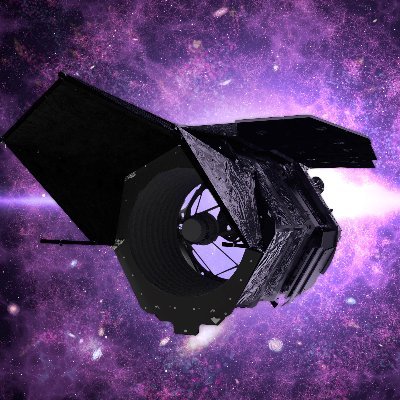

ALT Two people in head to toe white clean room suits stand in Goddard's large white clean room, staring up at Roman. Fully integrated, the telescope towers over them. Three irregular, elongated hexagon-shaped solar panels are the most striking part of Roman from this angle. The solar panels are gold with black squares covering almost their entire surface. Below the solar panels, which are several feet above the floor, the rest of the telescope is a silver cylinder, with various instruments protruding from its sides.


ALT A detailed view of the Moon’s heavily cratered surface, captured by the Artemis II crew on April 6, 2026. Credit: NASA


ALT Promotional graphic for the NASA Space Apps Challenge featuring three past participants holding award trophies. Text reads “Explore the Next Frontier” and announces the event dates, November 14–15, 2026. The NASA Space Apps Challenge logo and a registration link, spaceappschallenge.org, appear at the bottom.


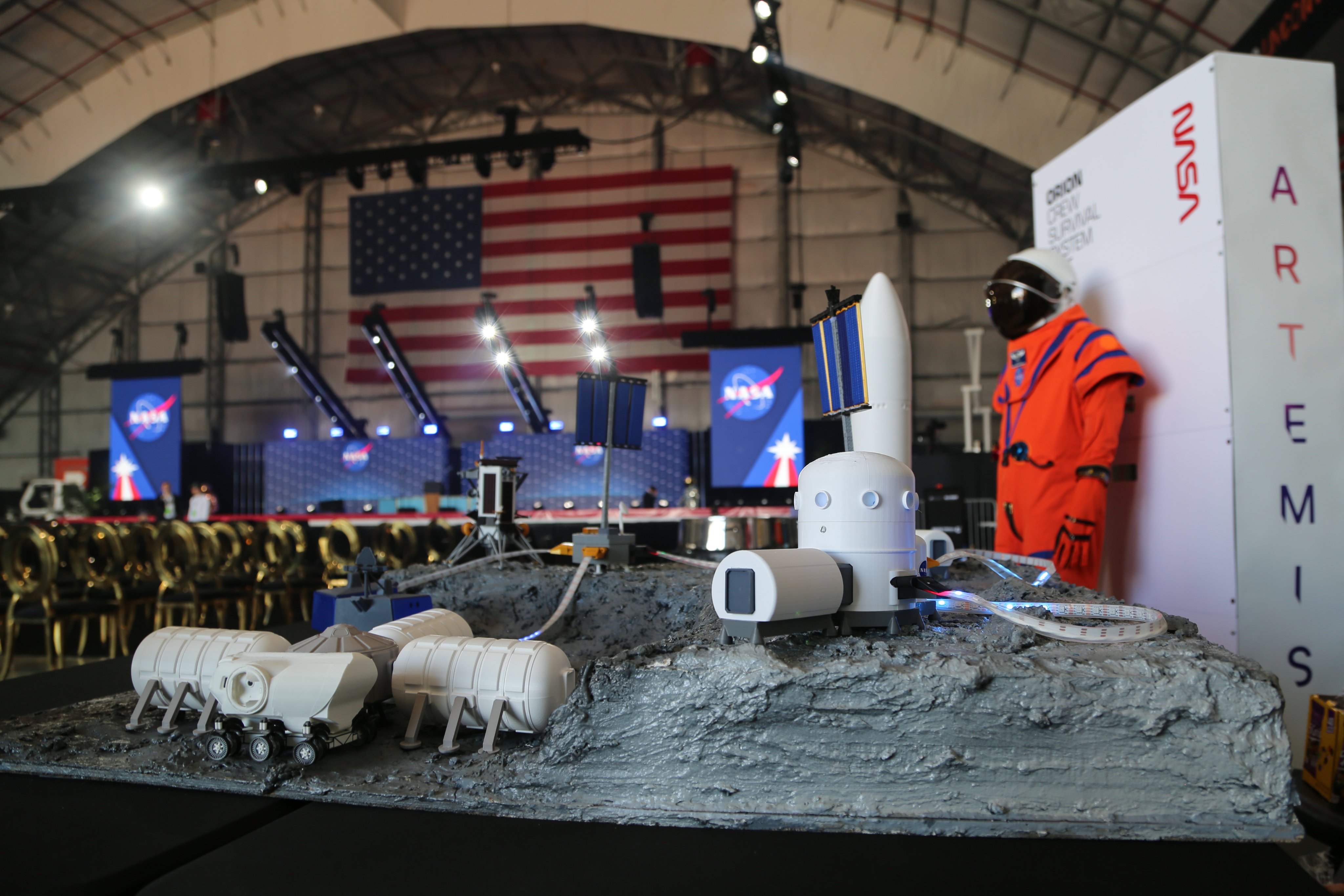
ALT A NASA exhibit at UP.Summit during MAX POWER on Nov. 6, 2026, features a conceptual lunar surface display illustrating the power infrastructure needed to support longer-duration missions on the Moon. In the foreground, miniature habitation modules and other lunar surface assets sit atop a gray, rocky terrain model, demonstrating how infrastructure could support sustained lunar exploration. The display is illustrative and does not represent a finalized Moon Base design. Behind the model stands an orange Orion Crew Survival System suit, with a stage and large American flag visible in the background. Credit: NASA/Briana Zamora

ALT A NASA Black Brant IX sounding rocket lifts off from Poker Flat Research Range near Fairbanks, Alaska. It leaves a straight white trail of exhaust rising from a rural, tree-covered landscape into a blue sky with wispy clouds.