

Helping thousands of clients secure 100,000+ bitcoin—providing white-glove service to help you manage your bitcoin wealth since 2016. ✉️ [email protected]
Austin, TX
Joined November 2016
- Tweets10.7K
- Following862
- Followers58.4K
- Likes8.7K



Pinned Tweet
Today we launched the Bitcoin Security Stress Test.
Pick a custody setup, throw incidents at it, and see what survives.
Here's what happens when your custodian gets hacked, and how it compares with other custody approaches.
unchained.com/custody-stress…

Prepare for the future, decentralize everything.
Bitcoin is about to be acknowledged as critical infrastructure.
1
19
1,293
Unchained retweeted

If you want to understand the attacks happening on the Internet right now you should read "The Stars My Destination" by Alfred Bester.
In "The Stars My Destination" people have the ability to "jaunt" -- to teleport up to 1000 miles instantly at no cost to any location they can visualize. The world is completely changed by the advent of jaunting.
Continuous, round-the-clock crime waves circle the world as criminals jaunt to stay in perpetual darkness. Law enforcement becomes ruthless and abandons due process in attempt to keep society in order. Banks and other places that require physical security become labyrinths to prevent people from visualizing their interiors and jaunting in and stealing things. No one feels safe in their homes. There are no such things as good neighborhoods anymore because the entire world is connected and attackers can jaunt into your living room in an instant, for free. What a terrible world to live in....
Thankfully, in the real-world, we can't teleport! The simple fact that moving material things in our physical world costs money, requires energy, and takes time means that we are immune to the terrors of "The Stars My Destination".
Except online. On the Internet, we're jaunting all the time. You're doing it right now. Your phone jaunted through cyberspace and fetched this tweet for you to read. It a minute your phone will jaunt somewhere else, perhaps so you can read an article, or check the bitcoin price. And all these jaunts were instant and free.
The Internet is becoming an increasingly dangerous place because it was designed for the convenience of digital jaunting without considering the consequences of constant, instant, and free communication. We cannot simultaneously get all our content and services instantly for free and not expect attackers to jaunt in take advantage.
If we want to keep the Internet but avoid the dystopia of constant online crime, labyrinthine computer security, and the degradation of our rights and our privacy by our well-meaning protectors, then we need to attach at a *cost* to online communication. We must make moving through cyberspace more like moving through physical space. No more jaunting for free.
If we pay for the Internet, for each network request, with money rather than attention, then we will create a much needed distance on the Internet between attackers and us. This distance is not measured in meters, but in money, and its presence will allow us to build and defend good online neighborhoods, just as we are accustomed to doing in the physical world.
And, do I even need to say it? Fine, I will: BITCOIN.
NEW: The Bitcoin Policy Institute (BPI) has expanded into the Finney Foundation for Open Technology.

The Finney Foundation’s remit includes the full range of open technology: from open source AI to digital cash and encrypted messaging. Bitcoin remains a primary focus, and our Bitcoin programming under the BPI moniker will only expand.
As BPI does for Bitcoin, Finney will make the case in Washington that individuals should control the tools on which they rely, and that American strength comes from building in the open. We will champion open source software, privacy tools for all, and an optimistic vision of machines that serve their users, not corporate or state authorities.
The Finney Foundation thinks around corners. We provide our leaders with novel research, policy ideas, and educational programs that will, in the words of our namesake, make the computer a “tool to liberate and protect people, rather than to control them.”

Sv2 (@StratumV2) is gaining momentum, with several notable announcements in the past week from mining pools that make up ~35% of hashrate.
Sv2 can help secure mining connections, and further decentralize bitcoin by letting miners choose which transactions go into blocks.

While everyone was busy selling their Bitcoin to invest in the Anthropic IPO, Bitcoin showed huge momentum towards mining security and decentralization:
(a) Foundry announced testing of Sv2
(b) MARA mined their first block using Sv2
(c) Luxor announced they now supported Sv2
(d) P2PoolV2 beta is working well as a substantial portion of Testnet5 hashpower
While only the last one is an immediate mining decentralization win, supporting Sv2 in pool-work mode is an important first step towards miner Job Declaration and shows commitment by the mining industry to finally move forward, not to mention is a huge security upgrade for the entire Bitcoin system.
"I think what happens is: if the distribution mechanisms that we use to broadcast intellectual property become decentralized and peer-to-peer and pay-to-play, intellectual property itself dies. And that sounds terrifying, and anti-artist, but I don't think it is." - @dhruvbansal
1
3
1,502
If you want bitcoin to be a part of your long-term plan, consider where you hold it, too.
This November, your first year with an Unchained Bitcoin IRA is free. The first 21 clients also receive complimentary basic onboarding.
Use code BF2026 by 11/30:
my.unchained.com/sign_up
734
Unchained retweeted

The Binance security incident report mentions their hot wallet utilized MPC (multi-party computation) as a security method.
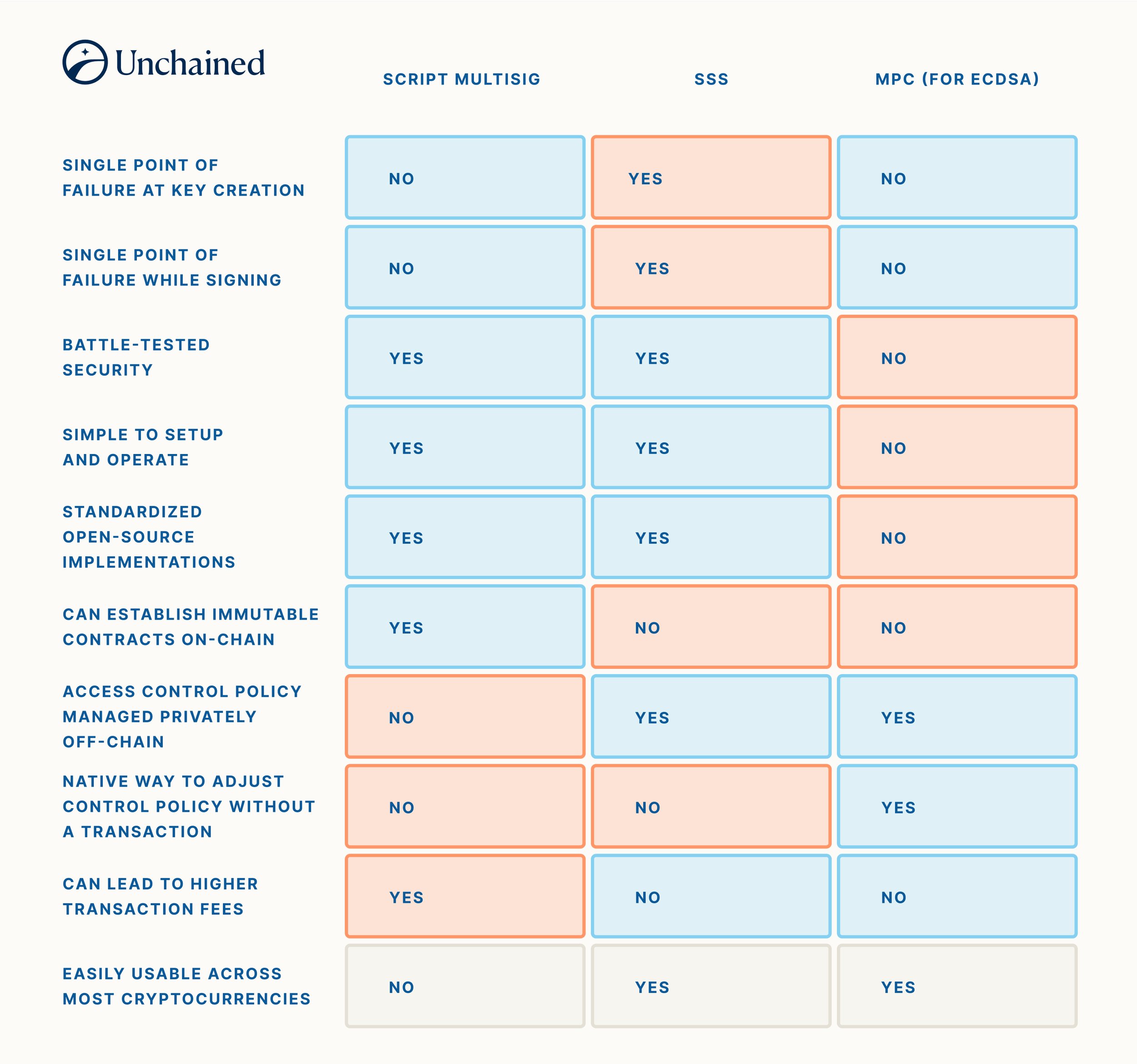
What's MPC? It's a way of creating threshold security, different from typical bitcoin multisig. With multisig, the threshold (e.g. 2-of-3) is enforced at the blockchain level, while MPC enforces thresholds at the key level.
This creates some tradeoffs. Keys can be used across different cryptocurrencies and blockchains, so MPC might be attractive to an exchange managing a bunch of altcoins, if they don't want to manage a separate setup for different coins. Operating at the key level also allows for more private management and security adjustments without public transactions.
However, MPC also sacrifices some of the simplicity, standardization, and transparency that can be achieved with script multisig. Multisig has proved robust for a longer period of time.
It's unclear whether MPC played a role in Binance's lost bitcoin, and I wouldn't make that assumption.
But some of the richest bitcoin addresses (controlling more than 550k BTC, or $40B) are attributed to Binance, and they all appear to be singlesig on the surface, while presumably utilizing MPC under the hood.
It could be interesting to see if they eventually decide to migrate those bitcoin balances to proper script multisig addresses (which MPC can optionally be used on top of).
Learn more about MPC, SSS (Shamir's secret share), multisig, and how they can be used together, here:
unchained.com/blog/mpc-vs-mu…

Satoshi Nakamoto built on contributions from various fields in the preceding years, many of which can be explored on the @NakamotoInst:
nakamotoinstitute.org/librar…
The video above pulls from this library, and was inspired by an original timeline image by @danheld.

If you participate in the tradition of reading the whitepaper today, you may be interested to take note of several errata that have been identified by @hrdng, as seen on the @NakamotoInst:
nakamotoinstitute.org/mempoo…
3
722
Unchained retweeted

This is probably one of the most wildly under-explored and under-implemented concepts in the space: unchained.com/features/bitco…
h/t @dhruvbansal

Stop trading one extreme for another and put your bitcoin in a retirement home. www.teapawt.org/Mandrik/status/2085154…


Self-custody done entirely yourself has gaps.
And exchanges also have gaps.
And ETFs have gaps.
The solution is eliminating all single points of failure with multisig. But multisig can be complicated.
That's why we pioneered collaborative custody. unchained.com/custody-stress…
