

An Adobe Company. Helping 28M+ marketers be found everywhere search happens
- Tweets214K
- Following10.7K
- Followers315K
- Likes38K






ALT This infographic compares Google Ads and ChatGPT Ads, presented in two columns. Key differences include search queries vs. user prompts, keyword signals vs. research prompts, and ad placement. Google Ads uses structured signals and direct ads, while ChatGPT Ads use conversational prompts and integrated content. The image highlights the need to understand audience needs, capture attention, test, and embrace creative strategies. The infographic is from SEMrush.

ALT Purple circle on the left with the text "Best CRM software for a distributed team?" Arrows point to the right side with a list of five queries: "Best enterprise CRM," "[CRM A] vs [CRM B] for enterprise," "CRM with data compliance," "CRM integrations with ERP," and "[CRM A] enterprise pricing.

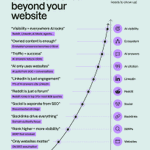
ALT This image is an infographic by SEMrush titled "SEO has moved beyond your website." It outlines various stages of SEO focus with a curved timeline. Key phrases are highlighted, such as "Visibility = everywhere AI looks," "Content needs to engage," and "Backlinks drive content discovery." Visual elements include icons representing ecosystem, AI, creators, social, backlinks, SERPs, and websites. A purple line with markers connects these points, indicating progress and evolution in SEO strategy.

ALT A pyramid diagram titled "How content optimization drives SEO growth" with four levels. From bottom to top: "Content library" with text stating "Historic content forms the foundation"; "Content grounding" explaining it "Finds, validates, and prioritizes pages to optimize"; "Refresh engine" stating it "Applies updates to improve accuracy and performance"; and the top labeled "Refresh cycles" explaining it "Transforms outdated content into renewed relevance." The diagram includes the SEMrush logo at the bottom.

ALT The image is an illustrative diagram showing a topic cluster linking example by Semrush, an Adobe company. It includes a central pillar page titled "Interactive dog toys: The ultimate guide" with links to three cluster pages: "Tug toys," "Chew toys," and "Interactive toys." Each cluster page links to subtopics like "Interactive pet toys," "Sensory chews," and "Toys for high energy dogs.

ALT Example customer journey for Home Depot visualized as a flowchart. The journey includes stages labeled as interest, query, referral, and brand, involving websites like Statmuse, Etsy, Overstock, Google, Amazon, Rysk, Johnson & Johnson, Skap, ChatGPT, Walmart, and Home Depot. The layout is linear and structured into three rows with connecting lines. The Semrush logo is displayed at the bottom right corner.

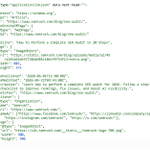
ALT Screenshot of code in JSON format detailing a webpage about performing a complete SEO audit. It includes metadata such as author, date published, organization (Semrush), and an image URL linked to Semrush's logo.

ALT Screenshot of a list of sources related to contract management software. One highlighted entry is titled "Best contract management software: a buyer's guide for 2026" from Juro.

ALT Sure! Here's an alternative text description: "Infographic titled 'Your first 10 minutes with Semrush + Claude connector.' It outlines steps for using Semrush with Claude for an SEO audit. Steps include connecting Semrush to Claude, starting a live data conversation, completing a domain SEO audit, and what Claude delivers from the audit. It also provides tips for improving the audit results. The Semrush and Anthropic logos are present.

ALT Flowchart illustrating "How people search" with interconnected nodes: User, Social, Reviews, Commerce, Website, Search, AI, Video, Action. Bottom right corner displays SEMrush logo and text "An Adobe Company.

ALT A grid of nine purple and black boxes, each numbered and containing a question related to data analysis and AI visibility. The questions cover topics such as demand validation, organization into topics, relevance, market breakdown, history trends, and evidence behind metrics.

ALT Spreadsheet titled "Keyword Mapping Template/Semrush." It has columns for Pillar Pages, Subpages, Keywords, Volume, KD%, Target URL, and Notes. Entries focus on topics related to puppy training, with varying search volumes and keyword difficulty percentages.

ALT Diagram titled "The structure of a topic cluster" by Semrush. It shows a central "Pillar page" connected to several "Cluster pages." The pillar page lists topics: "Keyword research," "Link building," "Local SEO," and "Technical SEO." Each cluster page corresponds to these topics.


ALT SEO-friendly site architecture diagram by SEMrush. Structure includes a "Home" page at the top, branching into two "Category page" sections, each with three "Individual page" subsections.