
Postdoc at MIT BCS, interested in language(s) and thought in humans and LMs
Joined March 2022
- Tweets219
- Following598
- Followers620
- Likes1.9K





Pinned Tweet
New preprint! 🤖🧠
The cost of thinking is similar between large reasoning models and humans
👉 osf.io/preprints/psyarxiv/m2…
w/ Ferdinando D'Elia, @AndrewLampinen, and @ev_fedorenko (1/6)

Andrea de Varda retweeted

Causal reasoning lies at the core of human intelligence but few studies have tested its neural basis. In a new study, we find that despite its importance, causal reasoning is implemented not in a single unified brain system, but rather in separate domain-specific regions.
Andrea de Varda retweeted

Had a wonderful time giving a guest lecture at Caltech on the cognitive architecture of LLMs, and more broadly, how we can use AI models as model organisms to study intelligence! :)
Many thanks to Prof. @CFCamerer for the invitation!
We discussed the emergent modularity in LLMs, what the similarities between human brains and LLMs might tell us about general principles of intelligence, and how AI models could help us study cognition.
Really enjoyed the discussions and questions! :)
Slides: docs.google.com/presentation…
(And special thanks to @devarda_a for letting me steal some of his beautiful slides! :))

The human brain is strikingly modular, with distinct networks for language, formal reasoning, social reasoning, and physical reasoning. Is this a fundamental principle of how intelligent systems are built, or an accident of biological evolution?
In our latest preprint, we find that a similar modular organization emerges in Large Language Models, another class of intelligent system.
Brains and LLMs are shaped by entirely different kinds of optimization (biological evolution vs. gradient descent). That they arrive at the same modular design anyway suggests modularity may be a fundamental property of intelligent systems.
🌐 Web: pengrui-han.github.io/LLM_Mo…
📄 Paper: pengrui-han.github.io/LLM_Mo…
💻 Code & data: github.com/Pengrui-Han/LLM_M…
Using circuit analyses across 46 tasks spanning four cognitive domains, we find:
1️⃣ Tasks that draw on the same network in humans recruit overlapping units in LLMs, while tasks drawing on different networks recruit distinct units.
2️⃣ These units are causally linked to model behavior. Ablating the units critical for one domain impairs performance in that domain (−26% accuracy) but barely touches the others (−2.5%).
This project has been in the works for a while :) Huge thanks to my advisors @jacobandreas @ev_fedorenko @devarda_a, and to @Nancy_Kanwisher for valuable conceptual input and feedback throughout. #MIT
Andrea de Varda retweeted

If you've noticed a distinct dialect emerging in frontier AI models and struggled to understand what they're talking about, you're not crazy!
We turned to psycholinguistics to investigate what makes the writing style so weird, and why this might be happening
🚨New preprint! 🧵

Andrea de Varda retweeted

New blog post! I wrote about why I think it's useful to use metaphorical (and anthropomorphic) terms to describe AI. I start by describing the role of metaphor in language and cognition, and how metaphors can help us to efficiently understand relations and make predictions 1/2

ALT in defense of metaphor: why metaphorical descriptions of AI are useful, even if they are sometimes imperfect. a watercolor of an MLP, with a thought bubble showing a path to a goal.
Andrea de Varda retweeted

Congrats to @devarda_a, named one of the 2026 #STATWunderkinds by @statnews!
Andrea is doing groundbreaking work in @ev_fedorenko + @roger_p_levy labs to understand how brains and machines process language.
Learn more: statnews.com/wunderkinds/and…
@mitbrainandcog @ScienceMIT

Thrilled to be one of @statnews's 2026 #STATWunderkinds for my work on language processing and reasoning in 🧠 and 🤖
Big thanks to my current/previous advisors @ev_fedorenko @roger_p_levy Marco Marelli and everyone I get to work with!

Andrea de Varda retweeted

Why do neural networks become modular? Our paper is now out in Nature Machine Intelligence! @NaturePortfolio We show that multi-task learning promotes modularity under limited capacity and task demands help explain features of brain architecture in addition to the spatial constraints.
Great thanks to all the co-authors. @WHYWYH007 @yifannnwu @DaniSBassett @marcelomattar
rdcu.be/YJ12NBxvrHsa

Check out CogGym, led by @LanceYing42! 258 experiments from 100 cogsci papers (!!) in one format. Main takeaway: models are getting more human-like, but way slower than improvements on math and coding

Have we built machines that think like humans? 🧠🤖
In a new preprint, we propose CogGym, which compares AI and human judgments across 258 commonsense-reasoning experiments from 100 cognitive-science papers.
Paper: arxiv.org/abs/2609.21259
Platform: coggym.org

ALT CogGym workflow diagram: research experiments are standardized in EML by an LLM agent with human review, then rendered for human participants and computational models. Replicated and original human data are compared with model responses in a shared analysis.
Andrea de Varda retweeted

📄👀 Check out our new survey on Eye Tracking and NLP, where we reflect on past work in this space, and outline a roadmap for what's next.
Not needless to say - it's fully human written. The humans are Lena Jäger, David Reich, Omer Shubi and me. zenodo.org/records/22933169

Andrea de Varda retweeted

📢 The CORE COGNITION lab (core-cognition.github.io) is looking to hire another PhD student, working on automated scientific discovery and knowledge representation in cognitive science.
Starting date: March to September 2027.
🙏 Please share widely!
New preprint! 🤖➕➗
Shared circuits predict whether LLMs generalize across formats in arithmetic reasoning
w/ @sanapandey, @pengrui_han, @jacobandreas, and @ev_fedorenko
If you can solve 2+5, you can solve "two plus five" without learning math again. LLMs are more brittle (1/5)

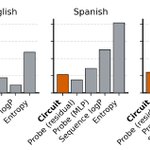
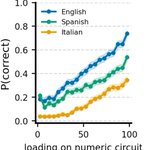
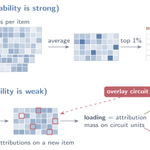
Circuit overlap predicts generalization at three levels: which formats are hardest (English > Spanish > Italian), which models generalize best, and which individual items get solved (fig below). If the numeric circuit is not engaged, the answer is almost always wrong. (4/5)

1
6
477
The circuit metric (unsupervised) predicts generalization as well as or better than supervised probes.
Behavioral generalization is grounded in circuit generalization: if the circuit does not transfer the ability does not either.
Pre-print 🔗 arxiv.org/abs/2609.04463 (5/5)

1
7
416
Andrea de Varda retweeted

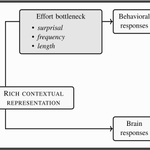
Go, @devarda_a! A beautiful and comprehensive study!🔑 finding: behav. measures are ~fully reducible to simple predictors of effort (surprisal, word length+frequency), but for 🧠 measures, LLM embeddings carry additional predictive power, likely capturing aspects of meaning.

New preprint! 🧠👀🤖
Behavioral and brain responses to language reflect different levels of linguistic representation
w/ @whylikethis_ , @ev_fedorenko , and @roger_p_levy (1/10)

Andrea de Varda retweeted
Wonderful work by @devarda_a linking behavioral and neural manifestations of language comprehension using language models. With @roger_p_levy and @ev_fedorenko
New preprint! 🧠👀🤖
Behavioral and brain responses to language reflect different levels of linguistic representation
w/ @whylikethis_ , @ev_fedorenko , and @roger_p_levy (1/10)
A similar asymmetry emerges within the effort measures. Eye movements are driven mostly by length and frequency (context-independent). Brain responses are driven mostly by surprisal (context-dependent). (9/10)
1
2
248
👀!=🧠
A unified theory needs both kinds of data with a clear understanding of which levels of representation each measure reflects. (10/10)
Pre-print 🔗 tinyurl.com/mr3cre4b
New preprint! 🧠👀🤖
Behavioral and brain responses to language reflect different levels of linguistic representation
w/ @whylikethis_ , @ev_fedorenko , and @roger_p_levy (1/10)

