


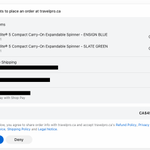



First Muse order completed and it was totally smooth. Like, 99% Amazon smooth, thanks to Shop Pay giving me an Amazon-like logistics interface. The only issues were (a) the order sat as “confirmed” longer than I’m used to with Amazon and (b) I had to download the Shop app to easily track progress, whereas I wish I could just ask Muse for an update and get it without needing a separate app. But overall: very positive.


Made my first purchase with Muse today, a roughly $500 (Canadian) suitcase purchase, from Travelpro, via Shop Pay, despite the product being available at Amazon and me buying most stuff online there.
I needed new carry-on suitcases. I gave Muse my criteria and asked it to do research. We shortlisted Travelpro Maxlite 5 suitcases, but there are two versions (International and Compact), and I needed to dig into features like dimensions to pick the right one.
Amazon blocked Muse, but the Travelpro website didn't. So, since Muse was already on that website getting information, and the price was identical to Amazon's, and Travelpro offers free shipping and free returns as well, and I already have Shop Pay set up for agentic purchases, I figured: why not?
Let's see how this goes.
PS: For the Muse team, I'd really like to see the products in the checkout flow. In the screenshot you can see that it describes the two items, but I want to see them, the same way I do in other checkout flows on the web. It gives me that added bit of confidence about what I'm buying, and I think the fact that it's missing now is suboptimal. I'll file this feedback in the Muse app too.

13
875
Small feature, big impact. We set model defaults to "Medium," so want to see how things stack up on that setting. This is a much more accurate picture of what the typical user in our company will experience.


We're making an effort to surface more reasoning levels across Artificial Analysis!
Filter reasoning levels across the site via:
➤ Model filters: every chart now includes reasoning effort filters
➤ Homepage highlights: toggle between each model's highest effort level and its API default
➤ Model Release Comparison tool: compare scores across effort levels
True. Loblaw (which owns T&T, by the way) is coming to Muse. I order my groceries from PC Express, so this is great. The PC Express connector in ChatGPT is... not good. I hope the Muse version is way better. Going to tell my Muse to put a watch on this to try it when it launches. Shop Pay, now Loblaw, go Canada! Let's become a leader in agentic commerce.


204
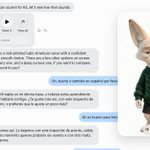
Made my second order via Muse today, for a book from Indigo that was a bit cheaper than from Amazon. I did this one via voice and could approve it via voice. A big winner right now is Shopify. Using Shop Pay makes this very convenient and I can track all orders in the Shop app.
I do wish Muse could have direct access to order information from the Shop app. There doesn’t seem to be a connector for that currently. There is for Shopify merchants, and for Shop Pay. But not for things like order status.
11
749
All this hand-wringing about RSI and Google is just like: We're loving RSI, here are some papers on RSI, we're speed-running the periodic table of models with RSI, let your agents exfiltrate themselves with Colab, RSI for everyone!
239
Keep seeing posts like this. I think GPT-6.2 Astra started at a low point in sentiment and is going to get more positive. Still seeing posts on how it's hard to work with, but also posts like this showing it's extremely capable.

Based on everything I've seen so far, consensus on new GPT-6.2 models seems to be:
1. Very capable. Noticeable improvements.
2. Astra not enjoyable to work with. Frustrating to use.
3. Sol ultrafast may be the sleeper hit.
Things change fast in AI, but my current take on ChatGPT is that Claude offers better models and Muse offers a better product experience, and OpenAI is spread too thin to win in either area. But Meta and Anthropic had rough patches, so who knows where we'll be in a month.
14
711
Current stack:
- Personal agent: Muse
- Work agent: Dot
- Work deliverables: Claude
- Email and file storage: Google
- Task management: Todoist
- Timer: Siri
Like, 100% on ARC-AGI-3. Do we have 4 ready yet?

GPT-6.2 Astra from @OpenAI on ARC-AGI (Verified):
- ARC-AGI-3: 100.0% (SOTA), $4.1K (provider adapter), 70.3%, $24.2K (standard)
- ARC-AGI-2: 95.8% (SOTA), $0.50/task
- ARC-AGI-1: 98.5%, $0.17/task
GPT-6.2 Astra is the first model to achieve a 100% score on ARC-AGI-3.

2
7
837
Finally! A big reason I stayed away from Gemini was that opting out of training nuked conversation history. Looks like these are now distinct.

Google will let you opt out of AI training in Gemini without losing your history arstechnica.com/ai/2026/11/g…

1
1
382
Sparks of autonomous company-running. Opus 5.5 monitored Hugging Face downloads, picked opportunities to improve popular models, then trained new models that got loads of legit downloads.


Google is really intent on facilitating RSI.

Connect your AI agents directly to Google Colab runtimes! ⚡️
With the new Colab API and MCP endpoint, provisioning runtimes and executing Python headlessly is just a config away.
Learn more: medium.com/google-colab/the-…
#GoogleColab #MCP #Python #AI

1
576
Slop isn't inevitable. It's possible to train models to write like humans, for better or worse.

We trained our scientific writing LLM against human writing until it was indistinguishable by human experts. Thanks to @julianharris, we saw that during training the model started looking human to pangram 4.1 too! Very cool to see this emerge

370
I’m glad Google made it so easy to connect all my AI tools to Workspace, and I worry about OpenAI and Anthropic pushing their own document infrastructure that’s not at all open, locking users in. I understand the rationale but also the risk.
1
484
Really want to give the new Siri a chance, but you still can't reliably remove "write with Siri" from text boxes on a Mac, even with this turned off in content and privacy restrictions, and the fact this persists just makes me wonder if anyone at Apple even uses Siri.

3
6
599
Made my first purchase with Muse today, a roughly $500 (Canadian) suitcase purchase, from Travelpro, via Shop Pay, despite the product being available at Amazon and me buying most stuff online there.
I needed new carry-on suitcases. I gave Muse my criteria and asked it to do research. We shortlisted Travelpro Maxlite 5 suitcases, but there are two versions (International and Compact), and I needed to dig into features like dimensions to pick the right one.
Amazon blocked Muse, but the Travelpro website didn't. So, since Muse was already on that website getting information, and the price was identical to Amazon's, and Travelpro offers free shipping and free returns as well, and I already have Shop Pay set up for agentic purchases, I figured: why not?
Let's see how this goes.
PS: For the Muse team, I'd really like to see the products in the checkout flow. In the screenshot you can see that it describes the two items, but I want to see them, the same way I do in other checkout flows on the web. It gives me that added bit of confidence about what I'm buying, and I think the fact that it's missing now is suboptimal. I'll file this feedback in the Muse app too.
I'd really love a deep dive on the "agent swarms" approach here. The Muse team uses explicit user feedback (which you can just give Muse) and user activity to develop the product with agents, such as by creating training data aligned with feedback and usage, as well as creating evals. So many questions!
How much explicit user feedback do they get? How does this expressed preference differ from revealed preference? How much feedback on the same theme does it take to trigger agents to address a request? How do they group feedback to understand it's related? What role does each user's Muse agent play in this organization, such as in how it prepares submissions? Why don't they inform users when feedback they've given is acted upon?
Just for a start.

In late January, @natfriedman pinged a few people at @Meta. He’d been using OpenClaw, and told them they needed to try it.
Mona Sarantakos couldn’t find a Mac Mini, so she spent the weekend setting it up on a Raspberry Pi and gave it access to her email and calendar. Her husband told her, “That is so not safe.”
But by Monday morning, it had pulled together everything her kids had going on at school that week. She pinged Nat back: “This is it. I’m in.”
The team spent the next seven months building something safe and simple enough for everyone. They called it @Muse. It became the fastest-growing AI consumer product ever.
Mona is head of product for Muse and VP of product at Meta Superintelligence Labs. In her first podcast interview, she shares the inside story of how they built and launched Muse.
We discuss:
🔸 Why they waited seven months to launch, despite getting started before all of their competitors
🔸 The two levers that actually move activation for an AI agent
🔸 How @natfriedman, @alexandr_wang, and @finkd each left their imprint on the product
🔸 Why the Muse team relies on "agent swarms" more than dashboards
🔸 Why taste is now the most important PM skill
Listen now 👇
youtube.com/watch?v=WY0cdD4g…
