






ALT Large, box-like structure of the Very Large Telescope under a dramatic twilight sky with streaked clouds. The landscape features rocky terrain in the background, illuminated by faint natural and green artificial light. Image credits: Toby Satterthwaite


ALT A construction site at twilight with a partially built structure illuminated by lights. The foreground shows construction materials and machinery. In the background, a silhouette of rolling hills is visible against a vibrant orange and purple sunset sky. Credit: Olivier Bonin/SLAC

ALT An aerial view of a construction site with a partially built, multistory structure surrounded by scaffolding. The site is located in a green, tree-dotted area with a parking lot and other low-rise buildings nearby. The sky is clear with a warm, colorful sunset. Credit: Olivier Bonin/SLAC

ALT A construction site at SLAC National Accelerator Lab during sunset. The sun is setting in the background, casting a warm glow over partially constructed buildings. Several work vehicles and equipment are visible in the area, surrounded by trees. Credit: Olivier Bonin/SLAC

ALT Aerial view of the SLAC National Accelerator Laboratory at dusk. The sky is a gradient of orange to deep blue, and lights illuminate the buildings below. Surrounding areas are visible with trees and roads. Credit: Olivier Bonin/SLAC

ALT Computer reconstruction of a psi-prime decay i the Mark I detector, making a near-perfect image of the Greek letter psi. (SLAC) Octagonal diagram showing particle paths with labeled symbols: \( \pi^+ \), \( e^+ \), \( \pi^- \), \( e^- \). Curved lines with crosses and squares indicate movement directions.

ALT Members of the experimental team taking the first look at graphs of the cross section showing the presence of the psi particle. Left to right are: Martin Breidenbach (seated), Gerson Golhaber, Ewan Paterson, Herman Winnick (from the Stanford Synchrotron Radiation Project group), and Francois Vannucci. November 10, 1974 at the Stanford Linear Accelerator SPEAR facility. (SLAC - V. Lüth) A group of people are gathered in a cluttered room filled with various electronic equipment and papers. One person is seated, writing or reviewing documents, while the others stand around, observing or discussing. The room has a vintage or historical look, suggesting a setting from a past decade.

ALT Two members of the SLAC/LBL research team check the counters and electronics used in the solenoidal magnetic detector [Mark I] (LBNL)


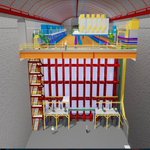
ALT A detailed 3D rendering of an underground construction site. The image showcases a cross-section view with multiple levels. On the top level, there are colorful pipes and machinery. The bottom level features a large structure with red beams and platforms, along with a few workers in hard hats. Stairs connect the levels, and the background shows the tunnel walls. Credit: Stephen Kenny, SURF

ALT A large underground facility with a high ceiling, featuring multiple rows of red machinery and equipment. The walls and ceiling are rugged, resembling a cave or carved rock, with bright overhead lighting illuminating the space. This is the Sanford Underground Research Facility. Credit: Stephen Kenny, SURF

ALT A person walks down a dimly lit corridor inside SLAC, surrounded by complex machinery and cables, bathed in a blue and orange glow. Credit: Alberto Gamazo/SLAC

ALT Aerial view of the SLAC National Accelerator Laboratory, showing a large complex of scientific buildings and facilities surrounded by greenery and roads. The landscape extends to distant hills under a cloudy sky. Credit: Olivier Bonin/SLAC

ALT Around 1200 people came to SLAC on Saturday, September 12 to enjoy 2026 STEM Community Day, a fun-filled afternoon that included activities for all ages. Attendees enjoyed interactive science, technology and engineering demos, mini facility tours, engaging displays, short science talks, fun photo ops and refreshments and giveaways. (Jacqueline Ramseyer Orrell/SLAC National Accelerator Laboratory)

ALT Around 1200 people came to SLAC on Saturday, September 12 to enjoy 2026 STEM Community Day, a fun-filled afternoon that included activities for all ages. Attendees enjoyed interactive science, technology and engineering demos, mini facility tours, engaging displays, short science talks, fun photo ops and refreshments and giveaways. (Jacqueline Ramseyer Orrell/SLAC National Accelerator Laboratory)

ALT Around 1200 people came to SLAC on Saturday, September 12 to enjoy 2026 STEM Community Day, a fun-filled afternoon that included activities for all ages. Attendees enjoyed interactive science, technology and engineering demos, mini facility tours, engaging displays, short science talks, fun photo ops and refreshments and giveaways. (Jim Gensheimer/SLAC National Accelerator Laboratory)


ALT Creating a molecular movie of penicillin biosynthesis: Researchers used ultrafast X-ray free-electron laser pulses to capture atomic snapshots of the enzyme as it reacted with oxygen. Combining these snapshots produced a molecular movie showing how nature builds the core structure of penicillin. (Greg Stewart/SLAC National Accelerator Laboratory)

ALT This image shows the orbital pathway of newly discovered dwarf planet candidate 2026 ED138 (ED138), as observed by NSF–DOE Vera C. Rubin Observatory. This image is a composite of multiple images captured by Rubin between 4 March and 11 July 2026 at intervals indicated by the teal circles. ED138 is visible at the center of each circle. (NSF–DOE Vera C. Rubin Observatory/NOIRLab/SLAC/AURA)

ALT A 3D abstract artwork featuring two layered grids with triangular peaks. The top grid is predominantly blue, and the bottom grid is mostly red. The grids' overlapping points create a dynamic, wave-like pattern on a black background.

ALT Inside the ICARUS detector. The detector uses liquid argon technology to detect charged particles created when a neutrino interacts inside it. (CERN)

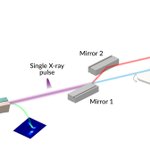
ALT Diagram illustrating an X-ray pulse setup with electron bunch entering an undulator. A single X-ray pulse is shown, passing through a series of mirrors labeled Mirror 1, Mirror 2, and Mirror 3, before splitting at Mirror 4 into two separate X-ray pulses. Credit: Greg Stewart/SLAC


ALT Composite photo with a background of dense stars and galaxies and a line tracing the orbital pathway of newly discovered dwarf planet candidate 2026 ED138 (ED138) on top of it. The line is a swooping blue line with small circles along it indicating where ED138 was when the photo was taken.

ALT A person inspects a large, complex machine, surrounded by numerous wires and equipment. The scene is brightly lit, showing intricate engineering and advanced technology. Data gathered from particle collider experiments using the BaBar detector at SLAC National Accelerator Laboratory, pictured here, were analyzed to search for traces of theorized dark matter particles known as dark photons. (Credit: SLAC National Accelerator Laboratory)


ALT Generate by AI Assist Dark abstract background with scattered glowing spots. Text reads: "Physics of the Universe" and "Invisible substance: how we are detecting dark matter." Credit: R Kaehler and Tom Abel/SLAC/KIPAC

ALT A graphic with large question marks and the text: "What is dark matter?" A text box explains: "An invisible form of matter that makes up 85% of all the matter in our universe. It interacts with gravity but doesn’t emit light." At the bottom, it asks, "So how do we find it?" The background features abstract wavy lines.

ALT A vibrant image showing cosmic rays as bright blue and orange streaks and spots against a dark background. Text overlay reads, "Fermi Large Area Telescope: A powerful instrument in space searching for excess high-energy gamma rays produced when dark matter particles annihilate or decay. Credit: NASA/DOE/Fermi LAT Collaboration

ALT An old-fashioned radio is set against a dark background with swirling lines and circles. Text boxes describe the Light Dark Matter eXperiment (LDMX) at SLAC, which aims to explore dark matter models, and a related experiment using superconducting devices to detect dark matter candidates.