

Data and Simulation Infrastructure for Physical AI
Santa Clara, U.S.A.
Joined February 2024
- Tweets234
- Following92
- Followers2.7K
- Likes154




Proud to support this year’s BEHAVIOR Challenge with 850 hours of high-quality, benchmark-grade teleoperation data.
100 long-horizon household tasks. 10,000 trajectories collected in simulation.
@StanfordSVL doubled the benchmark this year. We scaled the data to match.
265 participants took it on and lifted full-task success from 12% to 48%.
Congrats to the winners, and to the BEHAVIOR team for building the benchmark that pushes the whole field forward!

The results for the 2nd BEHAVIOR Challenge at CoRL 2026 are out! 🚀 In just one year, here's how far we've come together:
🏠 2× benchmark scale: 50 → 100 tasks, 3 → 7 scenes
👥 3× participation: 96 → 265 participants, 18 → 57 submissions
📈 4× full-task success: 12% → 48%
Congratulations to our winners!
🥇 The North Star, Huawei Noah EAI Team
🥈 IF1001, Intellifusion
🥉 Cyber, Xiaomi Robotics
Thank you to every team, from academia, industry, and independent labs worldwide, for making this year's challenge exceptional! 🙌
📝 Challenge description: www.teapawt.org/drfeifei/status/207672…
(1/N)

8
559
General-purpose models now drive robots directly.
So how do you scale robot learning?
At CoRL 2026, Christian laid out Lightwheel’s answer: one infrastructure that connects human data, simulation for evaluation and RL, and deployment into a continuous learning loop.
We launched RoboFinals RL Environments at CoRL as the newest piece of that loop: real work tasks in simulation with calibrated physics. A model keeps improving through reinforcement learning in simulation, and because the simulation is high-fidelity, what it learns transfers sim-to-real to the physical robot.
RL Environments build on the rest of our stack. EgoSuite is our egocentric human data, captured from real work. SimFoundry is our simulation foundation, with physics calibrated against the real world. RoboFinals is our evaluation benchmark, on the same tasks as the environments. RoboStack is our deployment system, taking models into real sites.
That loop is how agentic robotics scales.
#CoRL2026 #PhysicalAI #AgenticRobotics
🤖 Made with AI


What a week at #CoRL 2026 in Austin.
We launched RoboFinals RL Environments, and the conversations at our booth never stopped.
Robot models now understand tasks. What they lack is contact, force and precision, and those only come from practice.
RoboFinals RL Environments are where they practice. Every task comes from real work captured in EgoSuite, our egocentric human data. The simulation physics is calibrated against the real world. The task we showed at CoRL runs for more than 10 minutes with no resets.
Models train here and are tested on the RoboFinals benchmark, on the same tasks.
Access requests have been pouring in since launch. If your team trains robot models with reinforcement learning, join them:
lightwheel.ai/robofinals-rl-…
#CoRL2026 #PhysicalAI #Robotics
🤖 Made with AI


3
13
1,124
Today, Lightwheel is introducing RoboFinals RL-Env.
RL environments in simulation, built from real-world tasks and calibrated physics.
Most RL environments in simulation get two things wrong. The task is invented, not taken from real work. And the physics is tuned until it looks right, not calibrated.
RoboFinals RL-Env fixes both. Each task starts as a person doing the real work, captured by Lightwheel EgoSuite, and ends as an environment you can train in.
The first task is automotive repair. What’s inside:
→ Real tasks, captured by EgoSuite
→ Long-horizon, multi-stage tasks
→ Deformable, physically calibrated
→ Dexterous, contact-rich interaction
It runs Newton-native. And it shares its task definition with RoboFinals, so a policy trained here is evaluated on the same terms it was trained on.
One more thing. As EgoSuite grows, agents build new environments to match what it sees, and our experts review each one. One pipeline, every task.
Early access is open. If you train manipulation policies, join the waitlist. If you own a real task — a line, a ward, a warehouse — become a RoboFinals partner, and let’s make it a benchmark task.
lightwheel.ai/robofinals-rl-…
#PhysicalAI #ReinforcementLearning #Robotics #Simulation #RLEnv
@LightwheelAI x @UnitreeRobotics: partnering to advance real-world deployment.
Our shared goal: robots that perform reliably in the real world, improve with every deployment, and scale to industrial use.
The partnership brings together Lightwheel's physical AI infrastructure for data, simulation, evaluation, and deployment with Unitree's expertise in robot hardware, motion control, perception, and dexterous manipulation. Three areas of focus:
• Data: Egocentric human data from EgoSuite, built around the real-world tasks Unitree's robots are designed to perform.
• Simulation: Reinforcement learning in simulation, with industrial-grade evaluation on RoboFinals before robots enter service.
• Deployment: Through RoboStack, operational data from Unitree robots in the field returns to simulation and training, so each deployment strengthens the next.
Industrial-scale deployment takes hardware, models, data, and operations working as one system. Together, Lightwheel and Unitree are building that system, and the foundation for robots that keep improving throughout their working lives.
#Lightwheel #Unitree #PhysicalAI #Robotics

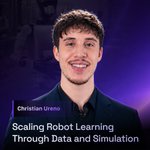
Join Christian Ureno at #CoRL2026 today on how Lightwheel scales robot learning with data and simulation.
📅 1:40 PM CT · 📍 Hilton Austin
Robots learn from humans and in simulation. Both have to be real. 100K hrs of human data w/ @huggingface, physics accurate enough for RL and RoboFinals eval, real robots feeding it all back.
Working on Physical AI? Come find us.

2
11
568
We’re co-hosting this at @corl_conf. Small table, strong opinions on sim-to-real, and the people actually deploying robots. See you in Austin 🍸

What takes a robot from an impressive demo to a useful deployment?
I'm co-hosting an exclusive dinner at CoRL with @LightwheelAI, @shotwellst, and @enact_labs for the researchers, founders, and engineers working on it.
Cocktails, a small table, and a conversation about sim-to-real, post-training, and getting robots working outside the lab.

Lightwheel brings physical accuracy to shared simulation assets. Now live on @NVIDIA SimReady Central.
Most simulation assets look right. Fewer behave right. Our work on SimReady Central is on the side that is harder to see: whether an asset’s contact, friction, mass, and joints hold up when a robot interacts with it in simulation.
What we do:
→ Agentic QA: simulate, tune collision and articulation, test again
→ Physical tuning grounded in real-world measurement
→ Schema feedback so physical properties are described consistently across solvers
If the physics is wrong, the benchmark is too.
Thanks @NVIDIARobotics @nvidiaomniverse for building SimReady Central in the open.

Rice. Paper bag. Rice cooker. One grasp, three kinds of physics.
Agent-generated on SimFoundry. Lightwheel’s solver coupler in Newton.
Watch the pour. No interpenetration. No grains leaking through the bag. Contact holds through the full tilt.
The agents that built the scene and assets don’t start from scratch. They draw on Lightwheel SimFoundry’s library of solvers and measured material parameters, so the rice, the paper, and the pot behave like the real thing, not like defaults. The coupler came out of the same work.
This isn’t a showpiece. It’s an evaluation task in RoboFinals, our Newton-native benchmark, where policies get scored on exactly this kind of contact. If the simulator can’t handle the physics, neither the policy nor the score means anything.
#PhysicalAI #Robotics #Simulation #Newton
8
25
1,726
@LightwheelAI × @Synopsys: two physics stacks, one calibrated loop.
That’s the story we brought to the Synopsys booth at @NVIDIAGTC Berlin last week.
Lightwheel runs the Real2Sim2Real loop: real-world measurement, Newton-based simulation, policy training and evaluation at scale. Synopsys brings @ANSYS Motion, the industry standard for multibody dynamics and component-level mechanics. Put them together and you get simulation that is validated against the real world from two directions at once.
Here’s what that looks like on an cable insertion task:
Lightwheel instruments the real robot, capturing insertion force, cable dynamics and contact events, and sets the calibration targets.
Ansys Motion maps the load path inside the connector, showing exactly which mechanisms carry the insertion force.
Lightwheel’s agent-driven, task-level calibration then takes over, searching parameters, validating candidates and folding the result into Newton as a calibrated model that trains at full speed. Simulated insertion force now matches the real robot to within 5%.
Real-world data. Component-level mechanics. Agentic calibration at training scale. That’s the loop we’re building together!
174
Here’s what that looks like on an cable insertion task:
Lightwheel instruments the real robot, capturing insertion force, cable dynamics and contact events, and sets the calibration targets.
Ansys Motion maps the load path inside the connector, showing exactly which mechanisms carry the insertion force.
Lightwheel’s agent-driven, task-level calibration then takes over, searching parameters, validating candidates and folding the result into Newton as a calibrated model that trains at full speed. Simulated insertion force now matches the real robot to within 5%.
Real-world data. Component-level mechanics. Agentic calibration at training scale. That’s the loop we’re building together!
86
Lightwheel is heading to @corl_conf (CoRL) 2026 in Austin.
Robot data is growing fast. Evaluation is now the bottleneck. So we're bringing the full Real2Sim2Real loop to Austin:
→ EgoSuite — collect human demonstration data at scale.
→ RoboFinals — test your policy in physics-accurate simulation.
→ RoboStack — deploy it on a real robot.
If you're working on robotics or physical AI and want to see how your policy holds up in real task, bring a checkpoint, we'll run it and show you the score.
See you in Austin.
#CoRL2026 #PhysicalAI #RobotLearning

Congratulations to @nvidia on launching the SimReady Central Library — the largest open collection of simulation-ready OpenUSD assets, with 3,500+ assets now on @huggingface.
Lightwheel is the largest contributor to the library, delivering SimReady assets available at launch across industrial, residential, and hospital environments.
Our SimReady assets are also built to the highest standard of physical accuracy. Each one carries validated mass and inertia, collision geometry that matches the mesh, and articulation and joint limits that behave as the real object does. Visual fidelity is a starting point. Physical fidelity is what robots need.
We believe open, physics-accurate SimReady assets are foundational infrastructure for Physical AI. That is why Lightwheel contributed at this scale, and why we will continue to, so that more robotics teams, labs, and partners can build on them.
Explore Lightwheel’s SimReady assets: lightwheel.ai/asset-library

1
2
511

Huge congrats to our partners at @dreamlabs_ai on the launch of Dream-1!
One model. Any two-armed robot. No retraining.
Excited to see this out in the world!

Today, Dream Labs is coming out of stealth with Dream-1, a robot foundation model that controls bimanual robots it has never seen, on tasks it was never shown, in places it has never been, from $3/hour.
Dream API is live for everyone, today. 🧵
9
660
Heading to #GTCBerlin? Come find us after keynote day.
@LightwheelAI and @NVIDIARobotics are hosting the RoboFinals Party. Keynote day ends, the real conversations start. The people who build the models, run the simulators, and write the checks, one room, open bar.
📅 Oct 21 | 6–11 PM
📍 Berlin Mitte, 15 min from Tempodrom and STATION-Berlin
🍸 Open bar, curated food and drinks
🎟️ Space is limited and attendance is by approval. Request your spot: luma.com/mctmd6xm
#GTCBerlin #PhysicalAI #Robotics #RoboFinals #NVIDIA
