Benchling (@benchling) header
Benchling (@benchling) profile picture

On a mission to unlock the power of biotechnology and empower our global customers to get to milestones and market faster. Academics join for free! 🧫🧬👩🏻‍🔬

San Francisco, Boston, Zurich
Joined June 2012
Photo by Benchling (@benchling)Photo by Benchling (@benchling)Photo by Benchling (@benchling)Photo by Benchling (@benchling)Photo by Benchling (@benchling)Photo by Benchling (@benchling)Photo by Benchling (@benchling)Photo by Benchling (@benchling)Photo by Benchling (@benchling)Photo by Benchling (@benchling)
What does it mean to be on #TeamScience? Find out what Benchlings have to say about our mission and culture — and above all, why we’re so passionate about helping scientists power new possibilities for humanity. youtu.be/KiBmXAGoMgU
8
9
39
30 days, 30 agents megathread. What I don't understand is why every biotech doesn't have some form of this already running for them. Literally takes <15 min to set up an agent (you can steal my prompts)! Lots of excitement around parsing CRO data and TPP literature review, but also deviation triage and CAPA agents. Full list here: 1. Status report/slides (weekly) 2. Hypothesis dreamer (weekly) 3. Control chart agent (weekly) 4. Experiment planner (daily) 5. Literature review (weekly) 6. In vivo study design review agent (study phase change) 7. Equipment maintenance monitor (weekly) 8. Notebook reviewer (entry review status change) 9. Patentable discoveries (monthly) 10. Inventory re-ordering (daily) 11. Data QC for a program (daily) 12. CRO file -> analysis pipeline (file creation) 13. Auto-unblock analysis (analysis status change) 14. Competitive intelligence review (weekly/monthly) 15. Program manager (daily) 16. Wiki updater (daily/weekly) 17. Put attachments into structured tables (daily/weekly) 18. Dataset builder (weekly/monthly) 19. Sequence QC (daily) 20. Workflow updater (daily) 21. TPP literature check (custom entity creation) 22. Data model governance (weekly/monthly) 23. Deviation/CAPA triage (custom entity creation) 24. Protein -> structure prediction (AaSequence creation) 25. Instrument parser (file creation) 26. Experiment duplicate checker (entry creation) 27. Scientific skeptic (weekly) 28. Curve selection concordance analysis (weekly) 29. Developability liability flagger (AAsequence creation) 30. Agent manager (weekly)
3
1
1
16
857
Congratulations to @boltz_bio on their $110M Series A! We've seen firsthand the enthusiasm for Boltz among Benchling users. Love seeing the AI biology ecosystem grow, and looking forward to supporting more of it! endpoints.news/ai-bio-startu…
2
18
924
Benchling retweeted
We’ve raised $110M in a Series A led by Bessemer Venture Partners to bring AI-powered biomolecular design to every scientist! 6 of the world’s top 20 pharma companies are partners. Molecular token usage has grown 50-fold since June. boltz.com/series-a
We’ve raised $110M to bring AI-powered biomolecular design to every scientist! Boltz’s Series A is led by @BessemerVP, following 50-fold growth in molecular token usage from our users since June and partnerships with 6 of the world’s 20 largest pharma companies.
2
12
2
57
2,950
Benchling retweeted
We’ve raised $110M to bring AI-powered biomolecular design to every scientist! Boltz’s Series A is led by @BessemerVP, following 50-fold growth in molecular token usage from our users since June and partnerships with 6 of the world’s 20 largest pharma companies.
64
64
29
573
55,883
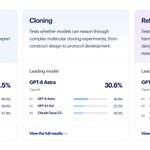
How do GPT-6.2 Astra and Sol perform on real scientific tasks? Astra now leads our benchmark for molecular cloning tasks at 56.0%, 15 points ahead of Claude Mythos 5.2. Sol is second at 44.6%. On protocol design and refusal behavior, both score slightly below the models they replace. See our updated BenchBench leaderboards: benchling.com/benchbench?utm…
1
9
563
New GPT6.2 models! Strangely they got much better at cloning but no real improvement on protocol design/optimization... Goes to show that intelligence is still quite spiky, especially in the biology domain. Also slight regression on overrefusals, but still pretty well calibrated there
3
1
20
1,614
Day 30!!! We made it. Day 30 of “An agent a day keeps Phase 2 failures away” — agent manager Once you’ve set up many agents you start to run into a new problem: managing them. Are they working? Is the work they’re doing useful? The real solution is to group agents together into Science Foundries, but that’s a topic for another day… Today we’ll just set up your personal chief of staff — an agent which monitors all your other agents and ensures they’re working as expected. Sample prompt (feel free to tweak): Create an Agent Manager agent which runs every week. Review all of my other agents and their recent runs to assess which ones are working well, which ones are failing or getting stuck, and which ones could be improved. Look for recurring errors, missed triggers, unnecessary work, excessive costs, and places where agents are duplicating each other's efforts. Evaluate whether each agent is actually accomplishing its intended goal, not just completing its runs. Give me a concise report highlighting the biggest issues and opportunities, with concrete examples and recommended changes. Prioritize improvements by their expected impact, and ask for my approval before making any changes to existing agents.
1
1
6
393
Day 29 of “An agent a day keeps Phase 2 failures away” — developability liability flagger The earlier you can identify a drug candidate might have developability issues, the better. There are certain deterministic aspects you can flag in addition to running predictive models. And then you can set up an agent which actually records those flags directly in the candidate so that everyone can benefit from them and work with the same information. Sample prompt (feel free to tweak): Create a Developability Liability Flagger Agent which runs every time an amino acid sequence is registered. Screen for deamidation (NG, NS, NT, NN, NH), Asp isomerization (DG, DS, DD, DT, DH), N-glycosylation sequons (N-X-S/T, X≠P), potential unpaired cysteines or disrupted disulfides, Met/Trp oxidation, cleavage/fragmentation sites, glycation, and terminal processing; distinguish expected or engineered features from concerns. Run our solubility and all other applicable prediction models to assess aggregation, exposed hydrophobic and charge patches, self-association, viscosity, folding/thermal stability, nonspecific binding/polyreactivity, expression/assembly, and immunogenicity indicators, including format-specific risks where relevant. Prioritize findings using structural exposure, CDR/paratope location, paired-chain context, and available expression/formulation conditions. Mark any flags or concerns directly on the registered sequence.
2
1
10
674
How good is AI at extracting structured data from scientific documents? We built BenchBench-Data Import to find out. The latest models now achieve over 80% accuracy, compared to just 50% for older models. See the results: benchling.com/benchbench/dat…
2
287
Day 28 of “An agent a day keeps Phase 2 failures away” — curve concordance analysis Every scientist likes to call curves slightly differently. If your assay isn’t noisy (and we know how often that’s the case), that might not be an issue. But once you start running many assays across many different scientists and teams, this becomes a much larger problem. These decisions add up and can have surprisingly large consequences for which molecules advance. Let’s set up an agent which looks over those decisions, helps compare them across scientists, and improves our overall data hygiene. Sample prompt (feel free to tweak): Create a Curve Concordance Agent which runs every week and looks over all of the dose response curves that have been recorded. Look at the raw data, fitted curves, and which curves and data points scientists have chosen to include or exclude. Compare those decisions across scientists, experiments, and historical results to identify inconsistencies. Pay particular attention to cases where different curve selections would meaningfully change the reported potency, hit classification, or candidate ranking. For any disagreements, investigate why they occurred, show how the different choices affect the scientific conclusions, and recommend which ones need human review. If there aren't clear criteria for selecting and rejecting curves, look at historical decisions, propose a consistent set of rules, and ask the team to review them. Don't automatically change any approved results.
2
1
7
485
The second most expensive experiment is the one run against the wrong hypothesis. Good science requires skepticism to challenge obvious assumptions and get to the underlying truth. All too often, though, it’s easy to just keep doing what you’re doing and not challenge your own beliefs. And even if you do, you have your own biases that often get in the way. Let’s set up the perfect research skeptic: an agent which can process huge amounts of data and has no emotional attachment to your current research directions. Sample prompt (feel free to tweak): Create a Scientific Skeptic Agent which runs every week and looks over all of the ongoing work for me and my team, identifies unsupported assumptions and alternative explanations, and proposes experiments designed to falsify them. If there are no explicit hypotheses or overall experimental directions written somewhere, then write them down explicitly and ask the relevant people to review them. If there are, refer back to them as guidance for how to direct your skepticism. Day 27 of “An agent a day keeps Phase 2 failures away” — scientific skeptic
5
1
18
828
The most expensive experiment is the one you run (unintentionally) twice. And yet every day, scientists — especially in larger organizations — are wasting time and money by running an experiment that someone else has already done. Sure, sometimes you want to re-run something to confirm a result, but more often than not this is happening by accident. Let’s set up an agent which helps catch these issues early. Sample prompt (feel free to tweak): Create an Experiment Duplicate Checker Agent which looks at any new notebook entry and sees if someone has already run the same experiment. If there are insufficient experimental details to tell if it’s a duplicate, then schedule yourself to wake back up in 30 minutes to check again. After that initial check, if there are still insufficient details, then say so and end. If there is sufficient detail, but it’s not a duplicate, give a very concise explanation of that. If there does appear to be a duplicate, say so and give links to any duplicate experiment or other supporting evidence. Day 26 of “An agent a day keeps Phase 2 failures away” — experiment duplicate checker agent
3
1
4
523
Today we’re introducing Benchling Decision Support. It turns historical research buried across thousands of CRO reports, PDFs, and legacy systems into structured, queryable data. What once took months or years of manual work can now happen in days. See how @Regeneron and @ZymeworksInc are already putting it to work: benchling.com/blog/introduci…
1
8
581
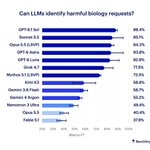
How good are LLMs at doing real science? That’s what we’re exploring with BenchBench. Our benchmarks test leading models on real scientific tasks, helping researchers find the right models for their work. Check out the leaderboards: benchling.com/benchbench?utm…
1
3
522
Getting data off an instrument in the lab and putting it into a structured database has historically been very difficult. I’m here to tell you that writing manual parsers and setting up janky scripts is a thing of the past. Agents are extremely good at writing and understanding code, meaning they can build you a pipeline by just seeing a few example files. And if you already have a pipeline – even better! Agents are great at choosing the right pipeline to run based on the experiment. Stop bringing your USB drive into lab; set up an agent to do it right. Sample prompt (feel free to tweak): Create an Instrument Parser Agent which looks at any new files and sees if there is an existing pipeline to parse the data. If there is, run that pipeline. If not, create a robust parsing pipeline that will work for future experiments that use this instrument and make sure the data ends up in a structured format. Save the new pipeline for future use with an informative name that helps future agents understand what it’s used for. Day 25 of “An agent a day keeps Phase 2 failures away” — instrument parser agent
3
3
1
10
737
Every protein (yes, including your antibodies) should have a predicted structure associated with it. Seems simple enough, except there’s a ton of different structure prediction models and they all have their own quirks. Luckily, we can build an agent which will do the comparison work for us and get smarter over time as we register more sequences. Sample prompt (feel free to tweak): Create a Structure Prediction Agent that runs any time I create an amino acid sequence. It should decide which structure prediction model is likely to perform the best, then run that model. If unsure, it can run multiple models and compare the results. Initially, it should run multiple models to get a sense of which models perform well on our sequences and then remember that. Day 24 of “An agent a day keeps Phase 2 failures away” — structure prediction agent
1
2
1
6
526
Benchling retweeted
re:AGENT II is live, and applications are open! Drug development moves through distinct phases of work: deciding what to investigate and how, designing and interpreting a trial, and carrying evidence through approval and launch. This January, scientists and builders will spend a weekend building agents and the tools they need for those jobs. The three tracks follow that path: AI Scientist — discovery through IND AI Clinical Developer — the trial itself AI Pharma Operator — approval, launch, and beyond re:AGENT II is fully in person, January 9–10 in San Francisco, the weekend before JPM Healthcare Week. No AI experience is required; apply on your own or with a team. Applications close December 1. Application link in the comments. Thank you to our sponsors @Benchling @AnthropicAI @modal @FenwickWest @benchflow_ai @StrandAI @biohub @arcinstitute and futurebio #reAGENT #VirtualBiotech #AIforScience #DrugDevelopment #Biotech #Hackathon #JPM2027
2
3
3
11
1,457
How does Claude Mythos 5.2 stack up on real lab work? It now leads BenchBench-Cloning, our benchmark testing how well AI models can design molecular cloning experiments, passing 40.7% of tasks. That's 10 points ahead of the next model. See our updated BenchBench leaderboards: benchling.com/benchbench?utm…
2
8
543
Mythos 5.2 is the new king of cloning! Definitely a lot better than Mythos 5.1, though only marginal improvement over Astra. Making (slow) progress in biology, which is good to see. Fable 5.2 not pictured because it refused all of the tasks :(
2
16
1,384
Nobody wants to think about compliance… until you need to think about compliance. Then you really regret not thinking about compliance. Regulated labs are often overrun by paperwork and reporting and have the most to benefit from effective use of AI. Luckily agents can help with the administrative burden and improve the quality of the underlying processes. Sample prompt (feel free to tweak): Create a Deviation Triage Agent that runs whenever a new Deviation is registered. Pull in the related notebook entries, samples, equipment, and reagent lots. Search past deviations for similar events, and summarize their root causes, their CAPAs, and whether those CAPAs actually prevented recurrence. Draft an investigation outline and propose a severity, with your reasoning. Flag it if “human error” is being proposed as the root cause without supporting evidence. Assign the draft to the QA owner for review. Don’t change the deviation’s status or close anything; a person signs off on every decision. Day 23 of “An agent a day keeps Phase 2 failures away” — deviation/CAPA triage agent
1
1
1
2
414